
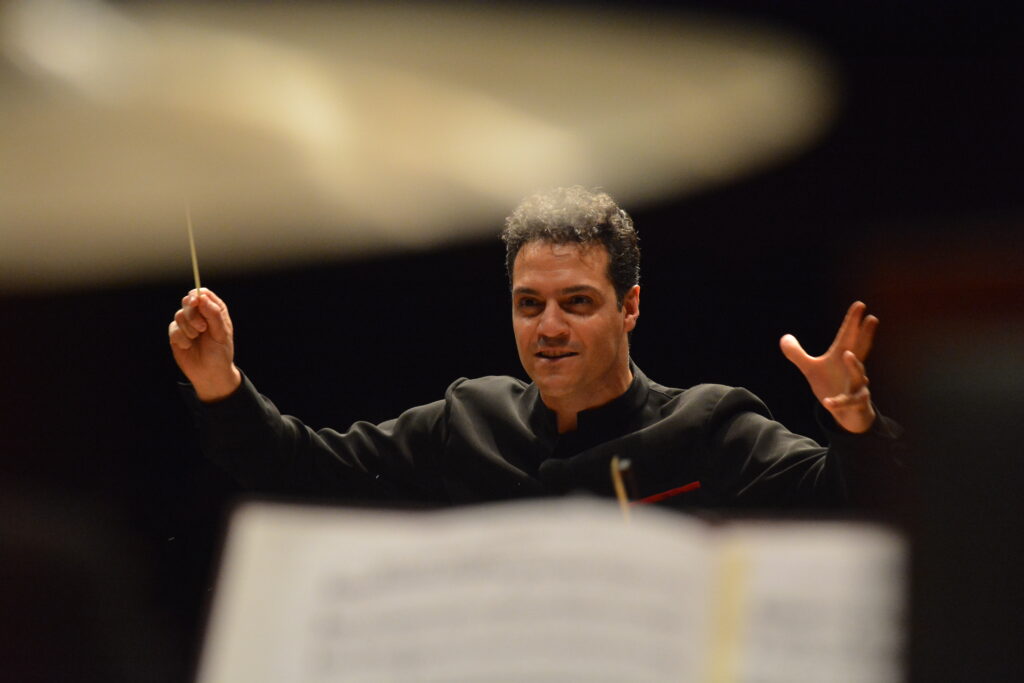
Giuseppe Montesano
Giuseppe Montesano’s path to the podium began long before conducting became his profession.
Growing up in Turin, music first meant piano, composition and choral conducting — different ways of exploring the same questions: how music is built, how it breathes, and how people can be brought together around a musical idea. Conducting gradually became the place where those interests could meet.
Download CV
READ FULL BIOGRAPHY
VIENNA AND THE PODIUM
He moved to Vienna to study orchestral conducting.
Vienna became particularly important in shaping his professional life. Working as assistant to Philippe Jordan with the Wiener Symphoniker and to Walter Kobera at Neue Oper Wien brought him into two very different musical worlds: the symphonic tradition on one side, contemporary opera and music theatre on the other. Rather than choosing between them, Montesano made both part of his musical identity.
BETWEEN STAGE AND CONCERT HALL
That duality has remained throughout his career. In the opera house, music is inseparable from drama, language, singers and the pulse of the stage. In the concert hall, the same search takes a different form: sound, structure, timing and the collective imagination of an orchestra.
Montesano has worked in both fields across Europe, collaborating with institutions and ensembles including the Teatro di San Carlo di Napoli, Theater Basel, Wexford Festival Opera, Mozarteumorchester Salzburg, Orchestra Filarmonica Arturo Toscanini, FORM – Orchestra Filarmonica Marchigiana and Orchestra Sinfonica G. Rossini.
BEFORE THE FIRST GESTURE
For Montesano, conducting has never been simply about standing in front of an orchestra. Much of the work happens before the first gesture: reading, questioning, hearing the score inwardly, understanding its structure, and deciding what needs to be shaped and what can be left free.
Rehearsal is where an interpretation meets reality — the sound, instincts and experience of the musicians in front of him. The aim is not simply to impose an idea, but to make it clear enough for it to become shared.
His background in choral conducting, together with a longstanding interest in the voice, has also shaped a particular affinity with the symphonic-choral repertoire, where orchestra, voices and text become part of a single musical architecture.
PODIUM AND CLASSROOM
This way of thinking naturally extends to another central part of his musical life: teaching.
Since 2022, Montesano has taught orchestral conducting at the Hochschule für Musik und Theater München, working with young conductors both individually and in regular projects with the Hochschulsymphonieorchester.
His teaching moves between conducting technique, score analysis and preparation, rehearsal methodology, critical listening and communication with the orchestra. Above all, it aims to develop the independence needed to make informed artistic decisions.
MUSIC WITHOUT A ROADMAP
Curiosity has kept contemporary music present throughout his career. From Milano Musica and Neue Oper Wien to collaborations with young composers and composition classes, new music presents a particular challenge: there is often no inherited performance tradition to fall back on — only the score, the musicians and the need to think independently.
The same challenge can arise when looking into the past. In 2018, Montesano conducted the first modern performance of Gaspare Spontini’s Le metamorfosi di Pasquale at the Festival Pergolesi Spontini, leading the Orchestra Sinfonica G. Rossini. Rediscovering a work that had disappeared from the stage for two centuries meant approaching the score without an established performance tradition. The production was subsequently recorded and released by Dynamic.
FROM PAGE TO SOUND
A career can be described through theatres, orchestras, productions and institutions. But for Montesano, the common thread is more fundamental: the fascination of taking something that exists silently on a page and discovering, together with other people, what it can become in sound.
That process begins again with every score, every orchestra and every student.